
- ASIC
- 电池管理IC与BMS解决方案
- 时钟和时序解决方案
- ESD 和浪涌保护器件
- 汽车以太网
- 评估板
- 高可靠性
- 隔离
- 存储器
- 微控制器
- 功率产品
- 射频
- 安全智能卡解决方案
- 传感器技术
- 小信号晶体管和二极管
- 收发器
- 通用串行总线(USB)
- 无线连接
- 英飞凌大中华区生态圈
- 搜索工具
- 技术
- 封装
- 订单
- 概述
- 嵌入式闪存eFlash IP 解决方案
- RAM和Flash多芯片封装MCP解决方案
- F-RAM铁电存储器
- NOR 闪存
- nvsRAM非易失性存储器
- PSRAM — 伪静态RAM
- 抗辐射和高可靠性的存储器
- SRAM静态随机存储器
- 晶圆和裸片存储器解决方案
- 概述
- AURIX™ TriCore™ MCU
- PSOC™ MCUs
- TRAVEO™ T2G MCUs
- XMC™ MCUs
- 传统微控制器
- MOTIX™ motor control SoCs/SIPs
- AURIX™ RC1 MCU
- 概述
- Calypso® 产品
- CIPURSE™ 产品
- 非接触式存储
- 了解 OPTIGA™ 嵌入式加密解决方案
- SECORA™ 安全解决方案
- 安全控制器
- 智能卡模块
- 政府身份证的智能解决方案
- 概述
- REAL3™ 3D ToF 图像传感器
- 电流传感器
- 气体传感器
- Inductive position sensors
- MEMS 麦克风
- 压力传感器
- 雷达传感器
- 磁性位置传感器
- 磁性速度传感器
- Capacitive sensors
- Temperature sensors
- 电池传感器
- Digital X-ray
- 计算机断层扫描
- Sensor interface ASICs
- 概述
- USB 2.0 外设控制器
- USB 3.2 外设控制器
- USB 集线器控制器
- USB PD 高压微控制器
- USB-C AC-DC 和 DC-DC 充电解决方案
- USB-C 充电端口控制器
- USB-C 供电控制器
- 概述
- AIROC™ 车载无线
- AIROC™ 蓝牙Bluetooth® 和多协议解决方案
- AIROC™ 互联微控制器
- AIROC™ Wi-Fi + Bluetooth® 组合
- AIROC™ Ultra-Wide Band Solutions
- 概述
-
AURIX™ TC2x - 32 位 TriCore™
- 概述
- AURIX™系列 – TC21xL
- AURIX™ 系列 – TC21xSC (无线充电)
- AURIX™ 系列 – TC22xL
- AURIX™系列 – TC23xL
- AURIX™ 系列 – TC23xLA (ADAS)
- AURIX™ 系列 – TC23xLX
- AURIX™ 系列 – TC264DA (ADAS)
- AURIX™系列 – TC26xD
- AURIX™ 系列 – TC27xT
- AURIX™ 系列 – TC297TA (ADAS)
- AURIX™ 系列 – TC29xT
- AURIX™ 系列 – TC29xTT (ADAS)
- AURIX™系列 – TC29xTX
- AURIX™ TC2x仿真器件
- 32 位TriCore™ AURIX™ – TC3x
- 32 位TriCore™ AURIX™ - TC4x
- 概述
- PSOC™ 4 Arm® Cortex® -M0/M0+
- PSOC™ 4 HV Arm® Cortex® -M0+
- PSOC™ 5 LP Arm® Cortex® -M3
- PSOC™ 6 Arm® Cortex-M4®/M0+
- PSOC™ 多点触控触摸屏控制器
- PSOC™ Control C3 Arm® Cortex®-M33
- PSOC™ Automotive 4: Arm® Cortex®-M0/M0+
- PSOC™ Edge Arm® Cortex® M55/M33
- PSOC™ Control C1 Arm® Cortex®-M0
- 概述
- 32 位 TRAVEO™ T2G Arm® Cortex®用于车身电子应用
- 用于仪表盘的 32 位 TRAVEO™ T2G Arm® Cortex®
- 概述
- 桥式整流器和交流开关
- CoolSiC™ 肖特基二极管
- 二极管裸片
- 功率组件
- 硅二极管
- 晶闸管/二极管模块
- 晶闸管软启动器模块
- 晶闸管/二极管盘
- 概述
- 汽车栅极驱动器
- 用于 GaN HEMT 的栅极驱动器 IC
- Gate Driver ICs for SiC MOSFETs
- Half-Bridge Gate Driver ICs
- High-Side Gate Driver ICs
- 电气隔离栅极驱动器
- 电平转换
- Low-Side Gate Driver ICs
- Three-Phase Gate Driver ICs
- 变压器驱动IC
- 概述
- BLDC 电机驱动器
- BDC电机驱动器
- 步进电机和伺服电机驱动器
- 带MCU的电机驱动器
- 使用 MOSFET 的桥式驱动器
- GaN EiceDRIVER™高速栅极驱动器
- 概述
- 车规级 MOSFET 30 V - 800 V
- 双 MOSFET
- MOSFET(Si 和 SiC)模块
- N 沟道耗尽型 MOSFET
- N 沟道 MOSFET
- P 沟道 MOSFET
- 碳化硅 CoolSiC™ MOSFET
- 250V至600V G14小信号MOS
- 40V Current Sensing MOSFETs
- 概述
- OPTIGA™ Authenticate
- OPTIGA™ Authenticate NFC 解决方案
- OPTIGA™ Connect – 交钥匙式 eSIM 安全解决方案
- OPTIGA™ Trust
- OPTIGA™ 可信平台模块 (TPM)
- 概述
- EZ-PD™ ACG1F 单端口 USB-C 控制器
- EZ-PD™ CCG2 USB Type-C 端口控制器
- EZ-PD™ CCG3PA Automotive USB-C 和 Power Delivery 控制器
- EZ-PD™ CCG4 双端口 USB-C 和 PD
- EZ-PD™ CCG5 双端口和 CCG5C 单端口 USB-C PD 控制器
- EZ-PD™ CCG6 单端口 USB-C & PD 控制器
- EZ-PD ™ CCG6_CFP 和 EZ-PD ™ CCG8_CFP 双单端口 USB-C PD
- EZ-PD™ CCG6DF 双端口和 CCG6SF 单端口 USB-C PD 控制器
- EZ-PD™ CCG7D 汽车双口 USB-C PD + DC-DC 控制器
- EZ-PD™ CCG7S 汽车单口 USB-C PD 解决方案,配备DC-DC控制器
- EZ-PD™ CCG8 双/单口 USB-C PD
- EZ-PD™ CMG1 USB-C EMCA 控制器
- 支持 EPR 的 EZ-PD™ CMG2 USB-C EMCA 控制器
按内核架构浏览
- 最新动态
- 航空航天和国防
- 人工智能和数据中心
- 智能汽车解决方案
- 通讯
- 消费类电子产品
- 工业
- 安全解决方案
- 智能家居和楼宇
- 解决方案
- 概述
- 资产跟踪
- Battery energy storage (BESS)
- 电池化成和测试
- Digital health
- 电动叉车
- 电动汽车充电
- 高压固态配电系统
- 氢电解
- 工业& 医疗 SMPS
- 工业自动化
- 工业电机驱动和控制
- 工业机器人
- LED 照明系统设计
- 轻型电动车解决方案
- 光伏
- 电源适配器和充电器
- 电动工具
- 电力传输和配电
- 机器人
- 轨交
- 不间断电源 (UPS)
- Wind power
- 概述
-
汽车电池管理系统 (BMS)
- 概述
- Automotive battery cell monitoring & balancing
- Automotive battery control unit (BCU)
- Automotive battery isolated communication
- Automotive battery management system (BMS) - 12 V to 24 V
- Automotive battery management system (BMS) - 48 V
- 汽车电池管理系统(BMS) - 高电压
- Automotive battery pack monitoring
- Automotive battery passport & event logging
- Automotive battery protection & disconnection
- Automotive current sensing & coulomb counting
- BMS (electric two- & three-wheelers)
- 电动汽车辅助逆变器
- 适用于建筑、商用和农用车辆的高压辅助应用
- REEV engine & HV starter‑generator control
- 用于电动汽车的高压 DC-DC 转换器
- 高压DC-DC转换器(商用车)
- 电动汽车充电
- 电动汽车牵引逆变器
- 燃料电池电动汽车动力总成解决方案
- 车载充电(电动商用车)
- 车载充电器(OBC)
- 电动两轮车和三轮车的车载充电 (OBC) 解决方案
- 牵引逆变器(商用车)
- 牵引逆变器(两轮车和三轮车)
- 最新动态
- 概述
- AIROC™ 软件&工具
- AURIX™应用软件
- DRIVECORE™ 用于汽车软件开发
- iMOTION™ 工具和软件
- Infineon智能功率开关和栅极驱动器工具套件
- MOTIX 软件&工具
- OPTIGA™工具和软件
- PSOC™ 软件&工具
- TRAVEO™ 软件&工具
- XENSIV™ 工具和软件
- XMC™ 工具和软件
- 概述
- EZ-PD™ CCGx Dock 软件开发工具包
- FMx Softune IDE
- Infineon GUI Designer
- ModusToolbox™ 软件
- PSOC™ Creator软件
- 雷达开发套件
- 锈
- USB 集线器控制器
- 无线连接蓝牙网状网络辅助应用程序
- XMC™ DAVE™ 软件
- 最新动态
- 支持
- 培训
- 英飞凌开发者社区
- 最新消息
季度报告
10/11/2026
商业财经新闻
09/11/2026
商业财经新闻
04/11/2026
商业财经新闻
02/11/2026
- 公司名称
- 我们的故事
- 活动资讯
- 新闻中心
- 投资者
- 职业生涯
- 质量
- 最新消息
季度报告
10/11/2026
商业财经新闻
09/11/2026
商业财经新闻
04/11/2026
商业财经新闻
02/11/2026

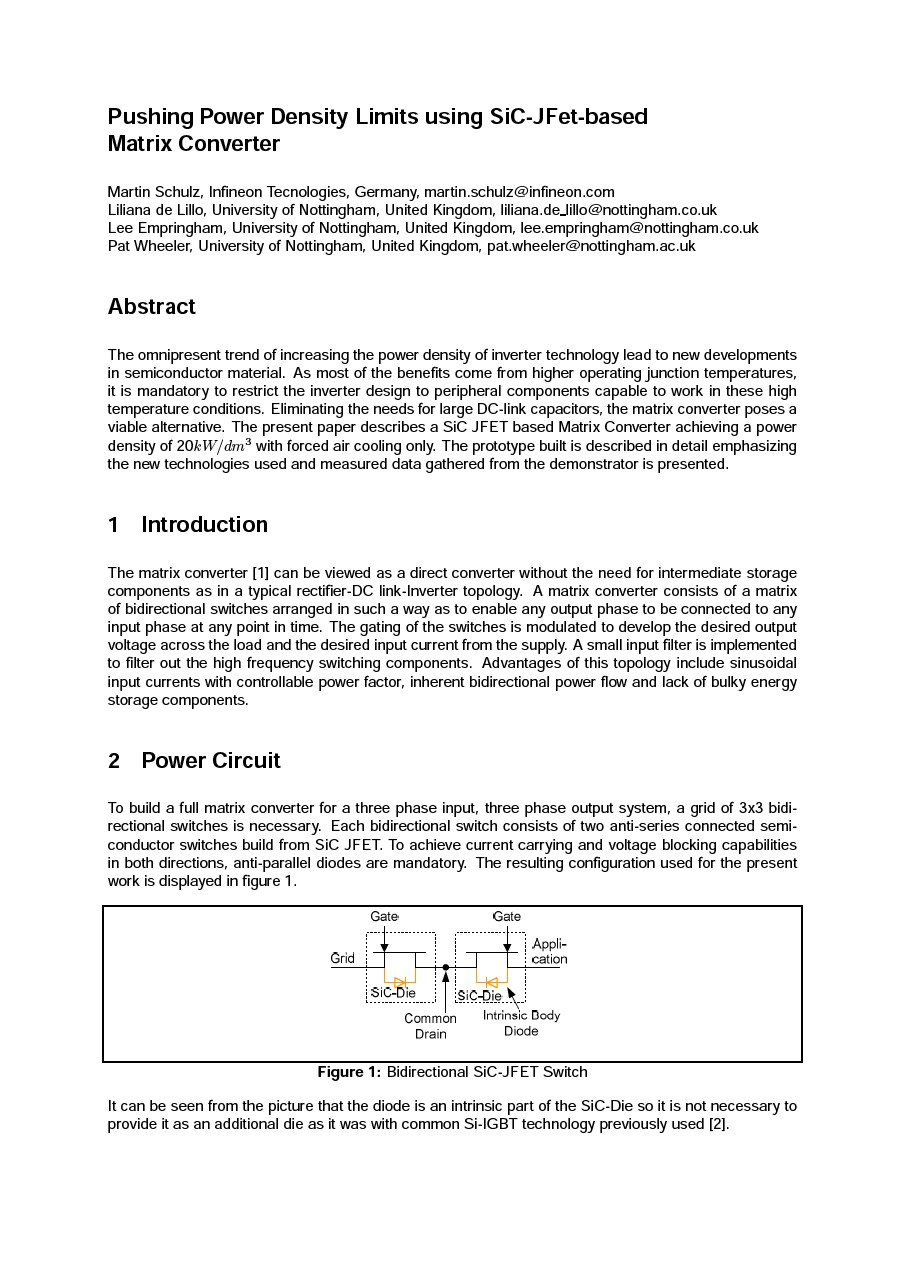
Pushing Power Density Limits using SiC-JFet-based Matrix Converter
The omnipresent trend of increasing the power density of inverter technology lead to new developments in semiconductor material. As most of the benefits come from higher operating junction temperatures, it is mandatory to restrict the inverter design to peripheral components capable to work in these high temperature conditions. Eliminating the needs for large DC-link capacitors, the matrix converter poses a viable alternative. The present paper describes a SiC JFET based Matrix Converter achieving a power density of 20kW/dm3 with forced air cooling only. The prototype built is described in detail emphasizing the new technologies used and measured data gathered from the demonstrator is presented. The matrix converter can be viewed as a direct converter without the need for intermediate storage components as in a typical rectifier-DC link-Inverter topology. A matrix converter consists of a matrix of bidirectional switches arranged in such a way as to enable any output phase to be connected to any input phase at any point in time. The gating of the switches is modulated to develop the desired output voltage across the load and the desired input current from the supply. A small input filter is implemented to filter out the high frequency switching components. Advantages of this topology include sinusoidal input currents with controllable power factor, inherent bidirectional power flow and lack of bulky energy storage components.
注册获取更多!! 注册